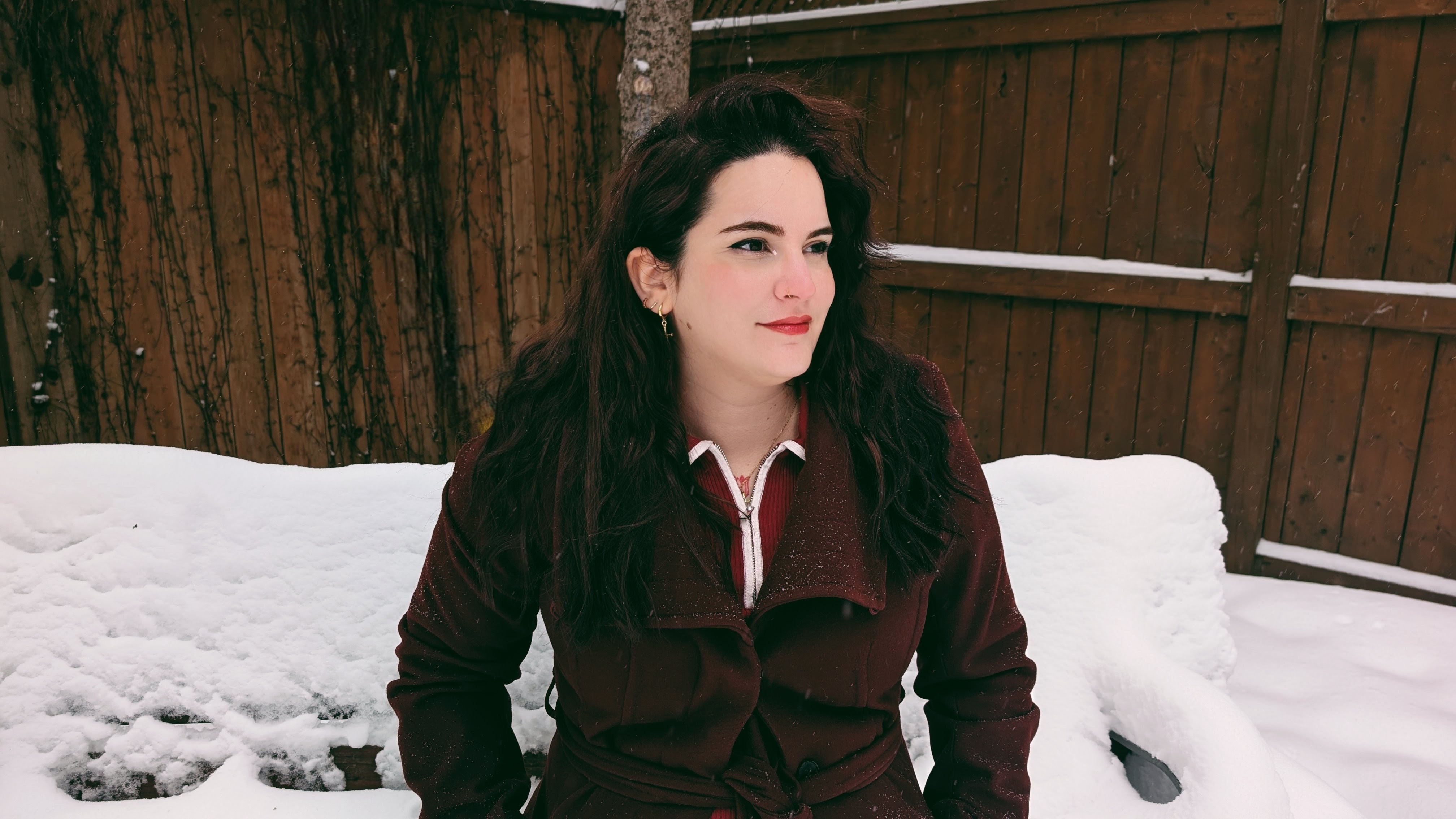
by Lys Granier.
This essay is published here as part of my ongoing exploration of how contemporary cities choreograph time, trust, and coexistence. It examines waiting—its architectures, its inequities, and its small civic rituals—as a lens on the moral life of Montréal.
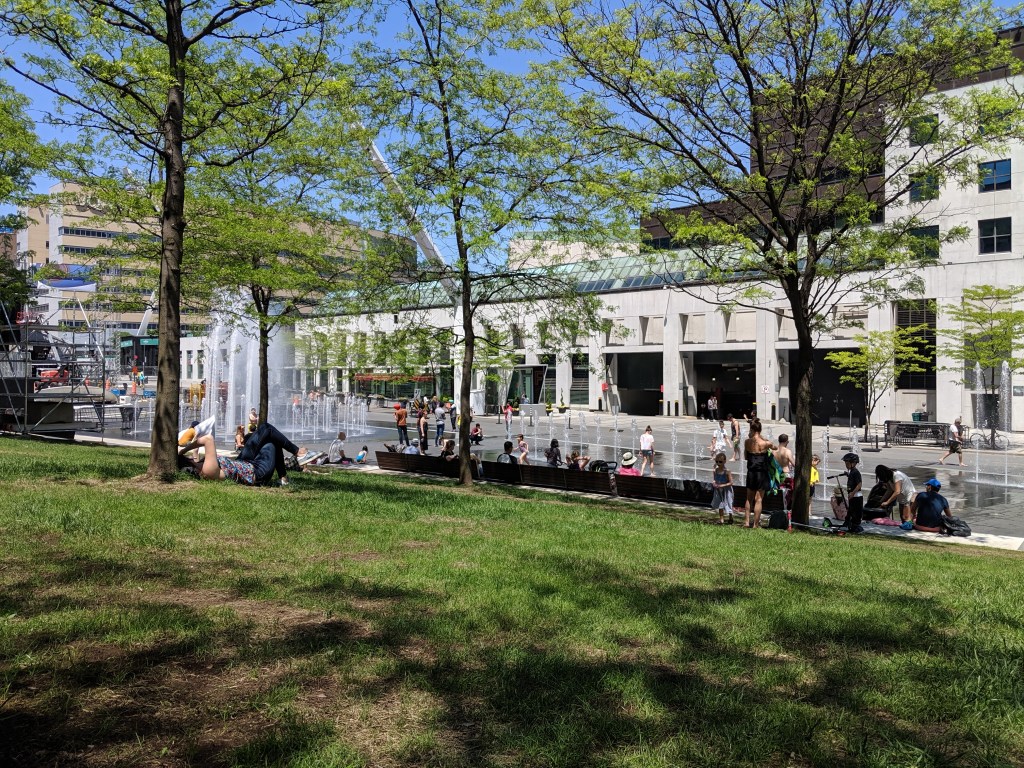
I. The Queue
It’s late July on Laurier Avenue, and the line outside Crèmerie Bo Bec curls along the sidewalk like a piece of dropped ribbon. The air smells of sugar and pavement heat. Someone has brought their dog, and a child traces the cracks in the concrete. Nobody minds the wait. The line moves slowly, the way summer asks us to.
Here, waiting feels like part of the pleasure. The people in line—students, families, couples in sandals—perform an easy civility. Each keeps a respectful space, half a step apart, as if proximity itself might melt the patience we’re practising. We’ve come for something small: a cone of soft ice cream, a moment of sweetness shared among strangers, out on the colourful bench out front. But in the rhythm of the queue, another craving hums beneath the surface—the longing for order that isn’t enforced, for coexistence that requires no sign.
The queue is the city at its most peaceful. No algorithm manages it, no guard supervises. Each person reads the unwritten code: first come, first served; everyone gets their turn. The choreography is self-sustaining—movement without authority, fairness without spectacle.
To wait like this is to participate in a moral experiment. The ice cream will melt either way, yet we agree to slow down, to align our appetites with one another’s. The line holds a fragile social truth: trust is not built in moments of speed, but in shared intervals of delay.
What does it mean to wait well in a culture that treats waiting as waste?The question lingers like the taste of vanilla on the air—light, ordinary, but hard to forget.
II. The Religion of Speed
By afternoon, Laurier Avenue hums with a different rhythm. Couriers weave through traffic, riders lean forward as if their speed could buy them time. Montréal, like every modern city, worships efficiency. The holiness of movement is visible in the choreography of its streets—everything designed to erase delay.
After years of acceleration—notifications, metrics, queued algorithms—we’ve forgotten how to stand still together.
We live in what sociologist Hartmut Rosa calls an age of social acceleration. The clock hasn’t changed, but our moral relationship to it has. The faster something happens, the more we trust it. Speed has become a proxy for competence; slowness, a sign of failure or decay. Even pleasure now comes with a timer. Delivery apps, self-checkout lanes, express elevators—each promises liberation from the minor indignity of waiting.
Yet this pursuit of immediacy carries a quiet anxiety. The time we save rarely becomes freedom; it becomes more work, more motion. Philosopher Byung-Chul Han calls this the “achievement compulsion”—a state where rest feels irresponsible. To pause is to risk invisibility. We have moralized momentum itself.
When a raspberry-dipped cone takes two minutes longer to appear, when a bus idles before departure, impatience rises like heat. We’ve learned to treat delay as an affront to dignity. But in erasing these intervals, we also erase the experiences that make coexistence visible—the brief acknowledgment of another’s slowness, the micro-negotiations of shared time.
The queue outside Bo Bec may look quaint, almost anachronistic, yet it resists this cult of velocity. It asks for nothing but presence. In that presence hides an old civic truth: a society that cannot wait cannot trust.
III. The Architecture of Delay
Every city expresses its ethics through design. You can tell how it values patience by how it builds places to wait. Montréal still has benches at most bus stops. They hold the slow pulse of civic life: people resting, scrolling, staring into mid-air. But across many cities, these same benches are being replaced by narrow leaning rails, tilted slabs of metal meant to discourage loitering. It’s efficiency rendered in steel—a gesture that says: pause, but not for long.
Hostile architecture is impatience made visible. Armrests divide benches so no one can lie down. Planters appear under awnings where the unhoused once found cover. Public foyers shrink into nothing as shops push seating outdoors, where consumption is required. The civic language is subtle but unmistakable: don’t linger, don’t wait unless you’re buying, move along.
Even digital systems participate in this redesign of time. Transit apps predict arrival to the minute, and delivery platforms promise “real-time tracking,” a term that suggests control over the uncontrollable. I’m no better. I refresh the bus app every thirty seconds, willing time to obey me. Yet the waiting never disappears—it merely shifts elsewhere, to someone unseen: the driver idling at the curb, the picker in a warehouse aisle, the worker refreshing an app for the next task. Impatience doesn’t eliminate waiting, it shifts it to someone else.
Still, the architecture of delay can be generous when a city allows it. A shaded bus shelter in summer, a heated vestibule in winter—these are structures of moral care, invitations to stay human amid urgency. They remind us that waiting, when dignified, becomes a civic right rather than a private inconvenience.
Waiting is a moral architecture, invisible but load-bearing. A good city doesn’t abolish delay. It shelters it.
IV. The Cultural Grammar of Waiting
Every culture choreographs delay in its own accent.
Often in Montréal, as in much of Canada, waiting is an act of quiet geometry. Lines form naturally, even in places with no visible order—outside food trucks, bus doors, cashiers. It is a moral language of distance: fairness measured in footsteps. To cut the line is not only rude but heretical. The queue embodies what the city believes about justice—time distributed evenly, patience as civic virtue.
In the sun of the Mediterranean, where I grew up, waiting has another grammar. People cluster, gesture, negotiate. A hardship to overcome for someone like me. You simply memorise who was there when you arrived, and who comes after you. Then you exchange a few polite “vas-y,” “non, toi, toi vas-y”—the inevitable dance of politeness. The line exists in conversation rather than in space. Fairness is maintained not by separation but by recognition. It’s slower, louder, more human.
To the Canadian eye, it looks chaotic. To the local one, it looks alive. There, to wait is to belong to a small public argument about whose turn it is—an ethics of encounter.
Famously, in Japan, patience becomes choreography. The line is quiet but collective, synchronised by the idea that one’s conduct reflects the whole. Order is not imposed but embodied, repetition turned into grace.
Each of these temporal rituals translates a society’s moral syntax: in Canada, justice as sequence, in the Mediterranean, fairness as dialogue, in Japan, respect as harmony.
To idealise any of them would be a mistake. Order, too, can become a form of control. The moralisation of punctuality once spread with the factory clock and the colonial railway—disciplining bodies to a single tempo.
To insist that virtue always lies in waiting quietly is to forget that patience, like time itself, has politics.
V. The Performance of Waiting
Not all waiting is humble. Some of it is theatrical.
On certain mornings in New York or Tokyo, people line up not out of necessity but for devotion—for a new iPhone, a sneaker drop, the first cronut of the week. The line coils around the block, alive with caffeine and anticipation, filmed for social feeds. Waiting becomes proof of taste, endurance, belonging.
In a culture that moralises speed, these ritual delays seem paradoxical, but they serve the same faith: the belief that value lies in scarcity, not duration. Here, patience is not civic but aspirational—a way to display loyalty to a brand, to rehearse identity in public. The queue is no longer an instrument of fairness but a stage of virtue-signalling. People photograph themselves in line as if patience itself were an accessory.
Compare that to the queue at Crèmerie Bo Bec, where time is shared rather than displayed. That line dissolves once the cone is handed over. No one posts about it—and if they do, it’s about the cone, not the wait. Its virtue lies in its anonymity—a small republic of appetite and restraint. But the spectacle line, the consumer pilgrimage, is vertical: it turns waiting into a ladder. The slower the access, the higher the status.
We’ve learned to turn even delay into performance. In a sense, the consumer queue redeems waiting only by monetising it. It’s patience with a marketing department. The difference is moral as much as spatial: one form of waiting binds us laterally, the other sorts us hierarchically.
Even in line, we rehearse our social order: some wait to participate, others to be seen waiting.
The spectacle of patience shows how completely we have blurred virtue and display, time and desire. Our capacity to endure is no longer a civic skill but a brand of its own.
VI. Unequal Patience
Not all waiting is chosen. For many, it’s the background noise of survival.
In Montréal, as in most cities, some bodies move freely while others are forced to linger: in welfare offices, emergency rooms, bus shelters at the edge of the network. The air in those rooms is thick with fluorescent hum and the smell of paper. Numbers flicker on a screen, and every change of digit feels personal. Time stretches unevenly across the map. A study in the United States found that low-income residents spend nearly six more hours a year waiting for basic services than those with higher incomes—six hours of unpaid, uncounted time. It’s the hidden tax of precarity.
Waiting, when involuntary, becomes a measure of inequality. The unhoused person waiting for a shelter bed, the newcomer waiting for a work permit, the commuter whose bus never arrives on time—they live inside the city’s delays, absorbing the friction its affluent citizens outsource. Each wasted hour compounds fatigue and invisibility.
One winter night I waited forty minutes for a bus that never came. Around me, people paced in their coats, our breath lifting into the orange streetlight. No one spoke. The longer we waited, the more we resembled each other—figures suspended between obligation and surrender. When the bus finally arrived, half of us didn’t board. The wait had changed what we were willing to do. I went back home and bathed my frozen feet in warm water.
Meanwhile, the middle class learns to aesthecise slowness: slow food, slow living, digital detox. They rediscover patience as a mindfulness practice, paid for by flexibility. Their pauses are elective, well lit, monetised. They wait for pleasure, not permission.
To speak of “the virtue of waiting” is therefore risky. Virtue assumes agency. The moral weight of delay depends on whether one can step out of it. For some, waiting is a posture; for others, a sentence.
Still, this inequality reveals something essential: time itself is a social resource, distributed like wealth. To wait well, one must first have time to spare. The rest of the essay’s question—what it means to wait well—begins here, in this imbalance.
VII. Shared Time
Despite its injustices, waiting remains one of the last truly public acts. A bus stop, a clinic, a government lobby—these are the few spaces where strangers still share unproductive time. Everyone has surrendered to the same rhythm: arrival uncertain, outcome equal. The first-come, first-served rule, so ordinary it feels invisible, is one of democracy’s quiet masterpieces. It suspends status and replaces hierarchy with sequence. For a few minutes, a city remembers what fairness feels like.
This fragile commons is disappearing. Algorithms have begun to privatise waiting. “Priority” lanes, express shipping, subscription fast-tracks—new currencies of time stratify experience itself. We no longer inhabit the same clock. Some move frictionless through the world while others idle in its wake. When empathy depends on simultaneity, this is not a trivial loss. To stand in line beside someone is to acknowledge them as equally subject to time. When that contact vanishes, so does the small moral calibration that tells us we are citizens, not clients.
The philosopher Simone Weil wrote that attention is a form of prayer, a kind of waiting without grasping. To wait, in that sense, is to hold oneself open to what cannot be rushed—justice, understanding, care. In civic life, the same rule applies. Shared delay is the infrastructure of compassion. It teaches us to bear each other’s slowness.
But shared time is a fragile privilege. When waiting becomes unbearable for some, the rest of us lose the ground of our own patience. If another person’s delay costs them food, warmth, or dignity, our civility becomes cosmetic. The commons of time can’t survive on empathy alone. It requires redistribution. Until waiting itself is safe, our virtue remains decorative.
A just city is not one without queues but one where waiting is distributed fairly, where benches remain, where time is not yet fully purchasable. The challenge is not to abolish delay but to dignify it—to build spaces where patience is possible without humiliation.
VIII. The Slow Gift
Evening returns to Laurier Avenue. The heat has softened, and the queue outside Crèmerie Bo Bec is short again. The sky over the rooftops has the colour of melted peaches. People linger after their cones, talking quietly on the curb. The rhythm of the street has slowed to something recognisably human.
The act of waiting now feels different—less a test, more a gift. The line has folded into conversation, a dog tugging at its leash, a child holding a cup upside down to catch the last drop. No one is in a hurry to leave. Time, for once, is not a commodity but a commons.
Perhaps this is what a city looks like when it still trusts itself. Not the elimination of friction, but its gentle acceptance. Waiting becomes a form of faith: faith that the ice cream will come, that the bus will arrive, that other people will keep their place in line. It is a modest faith, but it binds the city more deeply than any law.
When I think back to that queue—the quiet choreography of patience under the blue awning—I realise the line was never really about dessert. It was a rehearsal for coexistence, a brief suspension of the self in shared time. And beneath the sweetness, a pulse of something harder to name: boredom, tenderness, trust, all folded into one. And yet I know this patience is easier for some of us — the ones whose time is already protected.
A city’s virtue, in the end, is measured not by how fast it moves, but by how gently it pauses. The moral work of waiting is to hold the world still long enough for trust to take shape.
 Lys Granier